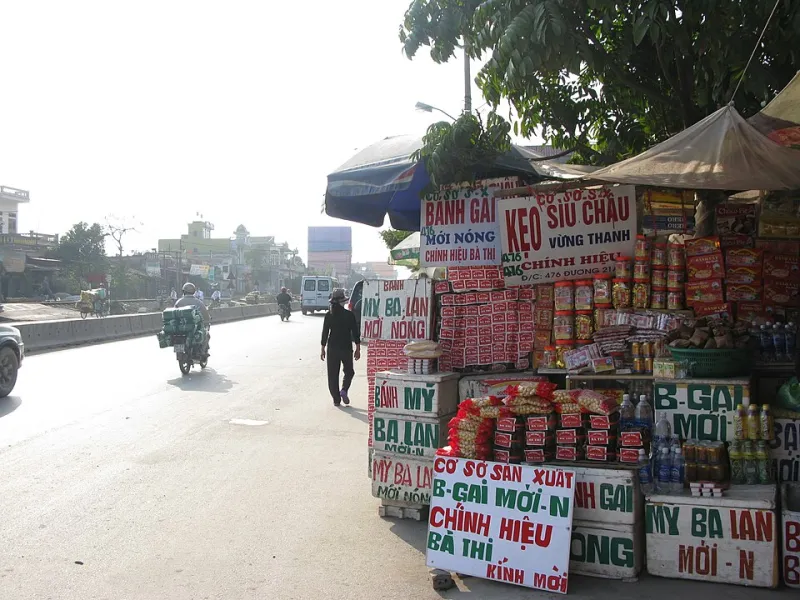
Paying 3X Too Much? The Hidden Markups Buried Inside Every Vietnamese Product on Specialty Store Shelves

Photo by Photo by Barney Goodman on Unsplash on Unsplash
You've probably done it. You walk into a Vietnamese specialty grocery, grab a bag of cà phê rang xay or a bottle of Maggi-style fish sauce, and think, yeah, that seems about right. But have you ever compared that price to what the same product sells for on a direct-to-consumer Vietnamese platform or even a niche Amazon storefront? The gap is often jaw-dropping — and it's not random.
At Siêu Thị Vai Ký, we decided to go beyond the sticker shock and actually trace where those extra dollars go. What we found is a layered system of costs that most shoppers never see — and once you understand it, you'll shop very differently.
How Vietnamese Products Get From the Farm to Your Cart
Let's start at the beginning. A 500g bag of Trung Nguyên Legend coffee might leave a roasting facility in Buôn Ma Thuột, Vietnam, at a cost of roughly $3–$4 USD equivalent. By the time it clears US Customs, that number has already climbed. Vietnamese coffee faces import duties that typically range from 0% to 6.4% depending on the product classification — but that's before you factor in the freight forwarder fees, port handling, cold chain requirements (for certain food items), and US FDA compliance documentation.
Add it up, and a product that cost $4 at origin is now landing at a US importer's warehouse for somewhere between $7 and $9. That's the baseline. Everything after that is markup territory.
The Middleman Multiplier
Here's where things get expensive fast. Most Vietnamese specialty stores in the US don't import directly. They buy from regional distributors — often based in cities like Houston, San Jose, or the greater Los Angeles area — who bought from a national importer, who bought from an overseas export broker. Each link in that chain takes a cut.
A typical distribution markup in the specialty food space runs 20–40%. A retail markup on top of that? Another 40–60%, sometimes more for low-volume, hard-to-source items. Run those numbers on our $7–$9 landed cost and you're looking at a shelf price of $14–$18 for a product that cost $4 to produce.
Compare that to a direct-to-consumer Vietnamese brand selling through their own US-facing website or through a platform like Weee! or Umami Insider. Those channels cut out one or two middlemen entirely. The same 500g bag might land at $8–$11 — still marked up from origin, but nowhere near the specialty store price.
Coffee, Sauces, and Textiles: Three Categories Where the Gap Hurts Most
Vietnamese Coffee is probably the starkest example. Premium robusta blends from brands like Highlands, G7, or Trung Nguyên are widely available on Amazon, often fulfilled by third-party sellers who import in bulk and operate on thin margins. You can regularly find 500g tins for $9–$13. Walk into a specialty Vietnamese grocery in Orange County or Eden Center and the same tin might be $18–$22.
Fish Sauce and Condiments tell a similar story. A 750ml bottle of Three Crabs or Phú Quốc-branded fish sauce retails for $4–$6 on most e-commerce platforms. In physical specialty stores, $8–$12 is common, and some boutique Asian grocery concepts price it even higher by leaning into the "authentic import" framing.
Vietnamese Textiles and Ao Dai Fabric are where the markup gets almost surreal. Hand-embroidered fabrics or traditional silk blends bought directly from Vietnamese artisan sellers on Etsy or through DTC platforms often cost 30–50% less than what you'd find at a Vietnamese cultural goods shop in the US — largely because the artisan is shipping direct and cutting out every domestic intermediary.
How to Calculate True Product Value Before You Buy
You don't need a supply chain degree to shop smarter. Here's a quick framework we use at Siêu Thị Vai Ký:
- Find the origin price. A quick search on Lazada Vietnam or Shopee Vietnam (use Google Translate) gives you a rough sense of what a product costs at the source. Convert to USD.
- Add a realistic landed cost buffer. For most packaged Vietnamese food products entering the US, assume the landed cost is 2–2.5x the Vietnam retail price after duties, freight, and compliance costs.
- Compare across channels. Search the product on Amazon, Weee!, and the brand's own website before defaulting to the specialty store. If the specialty store price is more than 1.5x the online price, you're likely paying a premium that doesn't reflect quality — just geography.
- Check for freshness trade-offs. Sometimes the specialty store price is justified by faster turnover and fresher stock, especially for items like bánh mì bread or fresh tofu. For shelf-stable imports, though, freshness is rarely the differentiator.
When the Specialty Store Markup Is Actually Worth It
We're not here to throw local Vietnamese businesses under the bus. There are real reasons specialty stores cost more, and sometimes those reasons matter to shoppers.
Small Vietnamese-owned groceries often serve as community anchors — they stock obscure regional products that no Amazon algorithm would ever surface, they employ Vietnamese-speaking staff, and they keep cultural commerce alive in diaspora neighborhoods. That has value. If you're buying rau muống seeds, dried shrimp from a specific coastal region, or a brand of bánh tráng that exists nowhere else in your city, the markup is the cost of access.
The problem is when shoppers assume specialty store pricing is always fair market value — and overpay for mainstream products that are freely available online at a fraction of the cost.
The Smarter Play
Think of it as a split strategy. Use online platforms — Amazon, Weee!, direct brand sites — for your staple Vietnamese pantry items: coffee, sauces, noodles, canned goods. Save the specialty store trips for the things you genuinely can't find elsewhere, or for when you want the experience of shopping in a Vietnamese-language environment.
Knowing the markup isn't about being cheap. It's about spending your money where it actually makes a difference — and keeping more of it in your pocket for the things that count.